SOUND CONTRASTS IN PHONOLOGY
Different contrasts.
Purposeful choices.
SCIP is grounded in four contrastive intervention approaches: Multiple Oppositions, Minimal Pairs, Maximal Oppositions, and Treatment of the Empty Set. Vowel Contrasts extends the options available to clinicians.
Approach descriptions by Dr. A. Lynn Williams, SCIP author.
01 / THE APPROACH
Multiple Oppositions
Uses a systemic approach to promote system-wide change in children with moderate to severe phonological disorder. The child’s substitute sound is contrasted simultaneously with 2, 3, or 4 targets selected from across a phoneme collapse, or rule set, directly addressing the homonymy that results when different words are produced alike.
For example, a child with a 1:17 word-initial collapse of obstruents and clusters to [t] might work on /k, s, tʃ, fr/ contrasted with [t]. The words Kai, sigh, chai, and fry—all produced as “tie”—are contrasted with tie to establish meaningful distinctions.
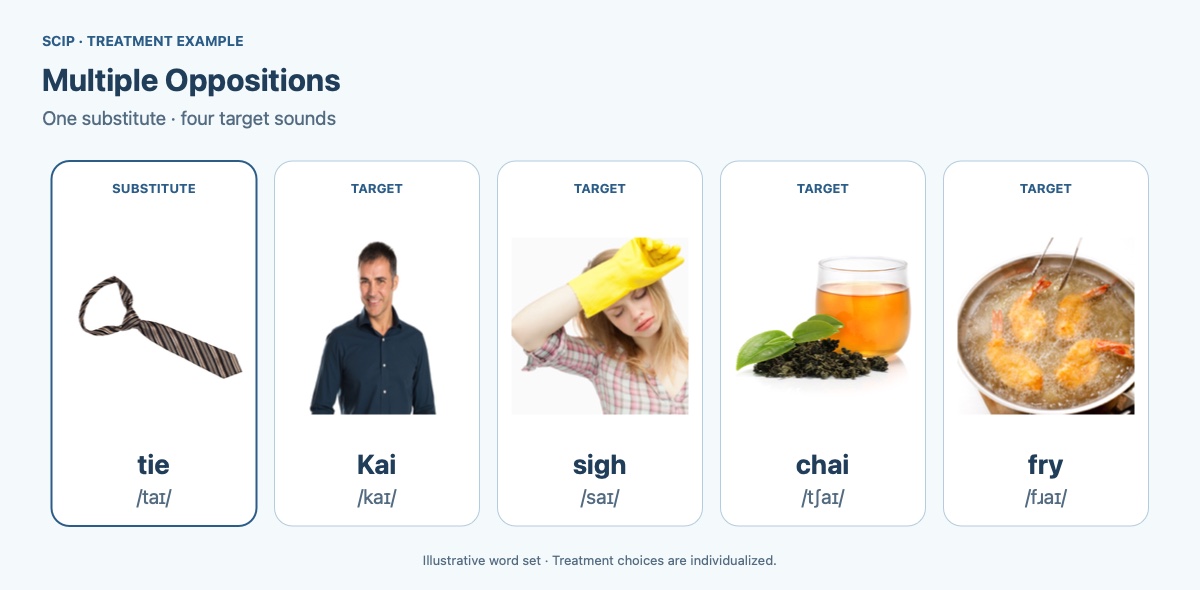
Example word set: tie · Kai · sigh · chai · fry. Select the picture for a larger view.
02 / THE APPROACH
Minimal Pairs
Uses a relational, “error-based” approach to address common phonological error patterns in children with milder phonological impairment. The target sound and the child’s usual substitute are contrasted in a one-to-one comparison that targets one error pattern, such as fronting.
Single contrastive word pairs, such as tea–key, directly address the homonymy that occurs when the child produces both words as “tea.”
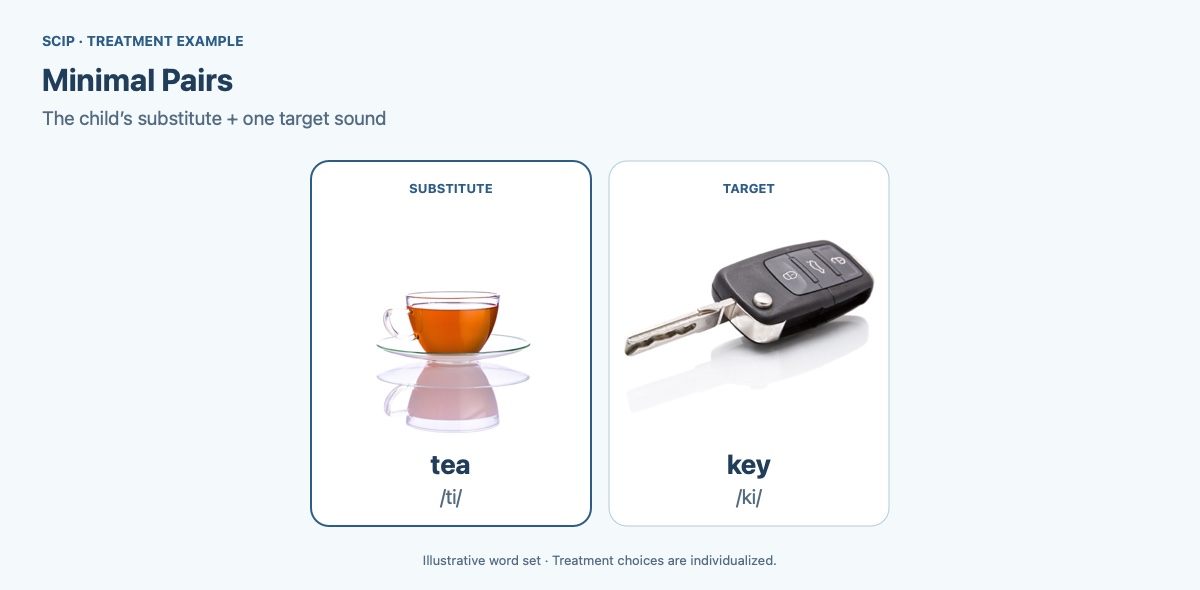
Example word set: tea · key. Select the picture for a larger view.
03 / THE APPROACH
Maximal Oppositions: 1 Target Sound
Uses a complexity approach to promote broader phonological change in children with moderate to severe phonological disorder. One target sound is contrasted with a sound that meets three conditions: it is independent of the child’s error substitute, differs maximally from the target, and is produced correctly by the child.
For example, if a child substitutes [w] for /ɹ/, /p/ could be selected to contrast with /ɹ/ in pie–rye. The /p/ is independent of the child’s substitute [w], differs maximally from /ɹ/ across a major class distinction—obstruent versus sonorant—and is produced correctly by the child. This approach does not directly address homonymy because the child produces the words differently: “pie” and “why.”
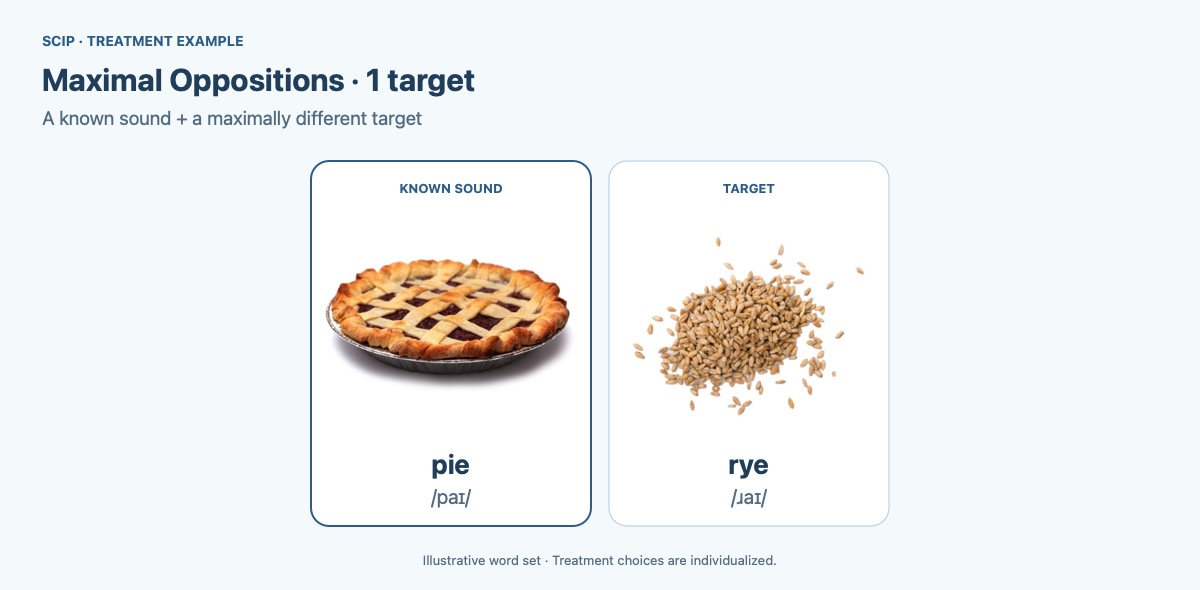
Example word set: pie · rye. Select the picture for a larger view.
04 / THE APPROACH
Maximal Oppositions: 2 Target Sounds (Empty Set)
Uses a complexity approach to promote system-wide change in children with moderate to severe phonological impairment. Two sounds absent from the child’s phonological system are selected as independent targets that differ maximally from each other, with an emphasis on later-developing, marked sounds.
For example, /ɹ/ and /dʒ/ differ across a major class distinction (i.e., sonorant versus obstruent), are later developing sounds, and are independent error sounds. Single contrastive word pairs, such as red–Jed would be produced by the child as “wed” and “dead.” This approach does not directly address homonymy because the words are already produced differently.
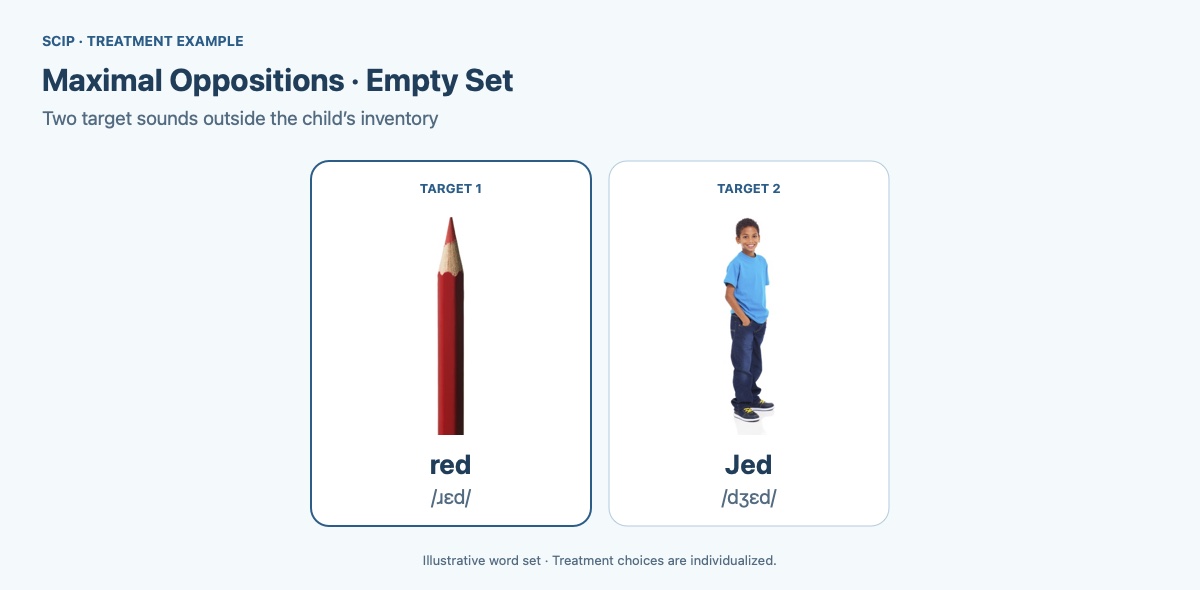
Example word set: red · Jed. Select the picture for a larger view.
05 / THE APPROACH
Vowel Contrasts
Addresses vowel errors, often observed in children with more severe phonological disorder, through contrasts that directly address homonymy. Multiple Oppositions is used when several vowels collapse to a single vowel substitute.
For example, a child who substitutes [ɛ] for /e, ɪ, æ/ could contrast bet–bait–bit–bat, all produced as “bet.” Minimal Pairs can also be used to address an individual vowel substitution through single contrastive word pairs, such as bet–bit.
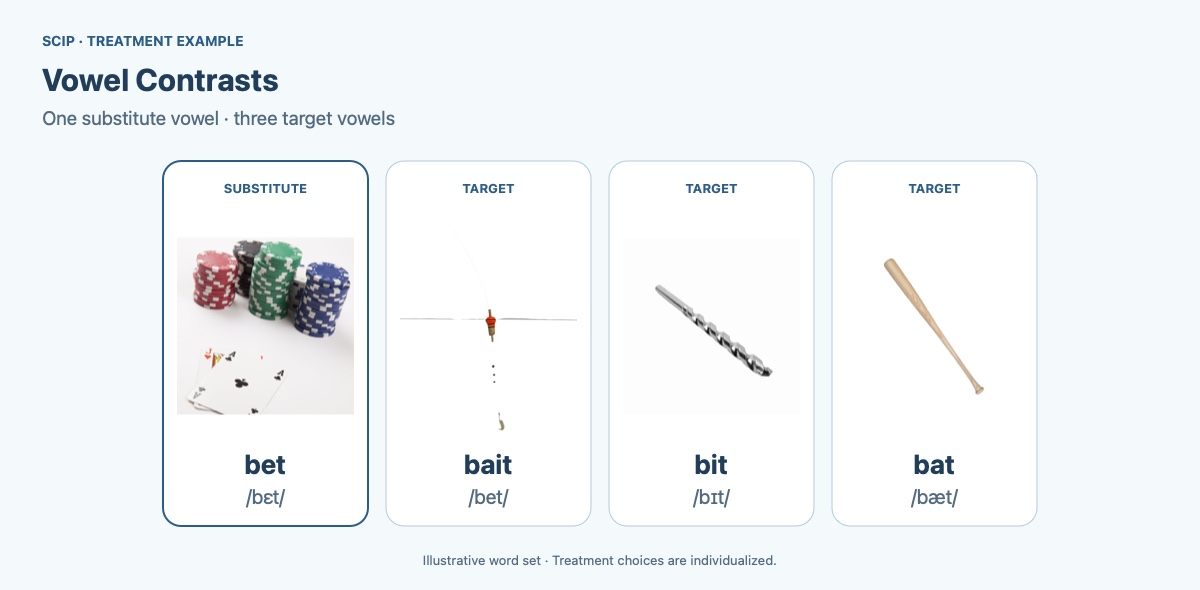
Example word set: bet · bait · bit · bat. Select the picture for a larger view.
Bring your clinical choices into practice.
Explore the SCIP Web features and choose the approach that fits your treatment plan.
Explore SCIP Web features →